


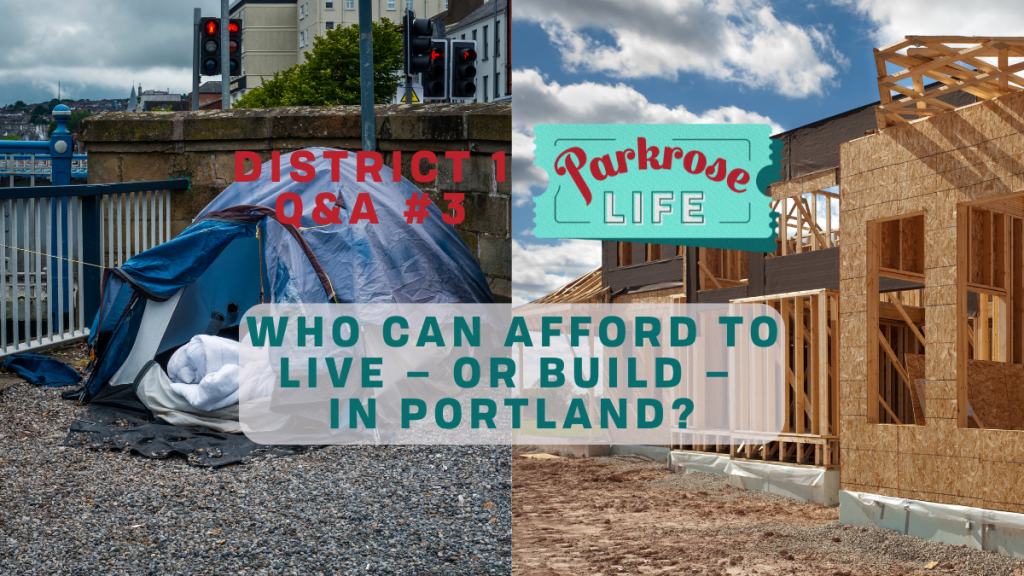
City council candidates addressing housing, homelessness
By Rob Cullivan, Contributing Writer
This November, Portland voters will select 12 city council members in the first election held under the new City Charter. Under the new system, voters will select three council members in each of the city’s four districts. Parkrose voters reside in District 1, which covers several neighborhoods east of Interstate 205 all the way to Gresham, as well as Portland International Airport.
Parkrose Life recently contacted all the declared candidates for District 1 (as of June 14th), asking them to state their positions and qualifications. We have edited their responses for clarity and length. This article is the third in a series of articles that will outline how the candidates think on various issues and why they believe voters should support candidates. To learn more about each candidate, read other articles in our series.

If you want to learn more about these candidates, stay tuned to parkroselife.com and Parkrose Life on Facebook. Hear candidates and meet them in person at the historic Rossi Farms barn on Wednesday, October 16 at 6:00 pm!
Question 1: What could you do as a city councilor to make rents more affordable?
Candace Avalos
Avalos would advocate for the following strategies:
Encourage Housing Development: Policies are needed to make it easier to build more housing.
Increase Affordable Housing: Develop more affordable housing by leveraging city funds, forming public-private partnerships, and securing state and federal grants to build housing for people at all income levels.
Advocate for Federal Rent Assistance: Secure more federal rent assistance to help low-income tenants. “Increased federal support could provide immediate relief for those struggling with high rent costs,” she says.
Enforce Existing Rent Control Laws: “I would advocate for stronger enforcement mechanisms to uphold these protections.”
Strengthen Landlord Registry: Enhance the Residential Rental Registration, making it mandatory and enforcing requirements for landlords to report the rents they charge. “Making this information publicly available can increase transparency and accountability.”
Fight for Tighter Rent Increase Limits: Tighten limits on rent increases to protect tenants from sudden and significant rent hikes. “This could involve proposing new legislation or amending existing laws for more robust rent control.”
Jamie Dunphy
Dunphy says Portland needs to rapidly increase the supply of housing — not just affordable housing subsidized by government, but all types of housing.
“First, our permitting system needs to be modernized in major ways. The city has begun to fix this antiquated, duplicative, and expensive system through the creation of a Bureau of Permitting.”
“Second, the city should be bending over backwards to accommodate any of the downtown building owners who are trying to convert their commercial office spaces into housing. And we should be opportunistic and nimble when those other downtown office buildings inevitably end up being foreclosed upon.
“The Montgomery Park building sold for over $300 million in 2019, and then sold for less than $35 million this year at foreclosure auction. The city should have been a bidder, and could have prioritized rapidly converting that building into … market rate housing that will help alleviate the downward pressure the housing market experiences. This won’t solve the housing crisis, but it’s a good start.
“Third, I will work directly with developers and the City’s economic development agency Prosper Portland to advocate for new dense development in Gateway, Lents, Parkrose, and other places where the zoning can accommodate multi-family housing, but development has historically been slow.”
Steph Routh
Routh wants “to increase our housing options across all income levels, and … ensure renters have reasonable protections that will allow them the housing stability that families need to thrive.
“I appreciate Onward Oregon (onwardoregon.org) for recently framing housing opportunity in an actionable way: ‘There are a number of new and recently built market rate apartment buildings listed for sale for under $250,000 per unit. The Portland Housing Bureau is financing a number of affordable housing projects that are costing more than $500,000 per unit. There are some extra costs associated with affordable housing financing and with building more 2BR and 3BR units, but not nearly enough to explain the difference.’”
Routh wants the bureau to buy “apartment buildings and/or developable land … currently on offer at prices below what we could build them in … parts of town well-served by transit with nearby access to parks and other city amenities.”
Routh says it’s “up to top-level people, including elected officials, to connect the dots and prepare a funding mechanism that can move quickly when opportunities arise that are worth seizing.
“If there’s no flexible local cash available, (an) elected official’s best role … is to relentlessly knock on Metro or OHCS’s doors until the state takes advantage of this big opportunity for the public and those of us struggling for housing.”
Routh noted she supports Portland’s changes to its Inclusionary Housing Program and is “eager for a single permitting authority.
“We also need to work closely with regional and state partners to fund a spectrum of housing types, including recovery housing.”
Tenant Protections
Most people get evicted for not paying rent, Routh says, noting “the best thing we as a city and region can do in these cases is to offer rental assistance, which supports both renters’ housing stability and landlords’ enduring incentive to keep rental housing as rental housing.”
Cayle Tern
Tern called for the formation of a task force “than includes all stakeholders” to solve the housing problem.
Among the solutions he believes could work are rent controls, vacancy taxes designed to incentivize property owners to rent to residents or businesses instead of leaving buildings empty), and “incentivizing rental contracts.”
“I believe that incorporating increased taxes on large corporations that buy, rent, and sell homes – for example, vacation rentals and Airbnb’s — can be a solution. Another solution can be redefining the poverty level so it reflects true affordable housing.
“We cannot just rely on building homes as a means to reduce housing affordability. We need to put all our options on the table.
David Linn
“We can support more housing solutions that create long-term rent stabilization. Community-led development through Prosper Portland and the Housing Bureau should identify many of the vacant homes and businesses throughout the city and find efficiencies in driving down the cost of building new affordable housing.”
Noah Ernst
“I will listen to landlords to understand if there are city policies that have the unintended effect of raising rents and will determine if those policies can be changed. I will look seriously at the impact of short-term rentals on the long-term rental market and rental prices. I will investigate the trend of large corporate entities buying single family housing stock and how that may be driving up home prices and rents.”
Sonja McKenzie
“It is critical to enact tenant protections and to preserve affordability of existing units. I would support current renters by enacting increased protections. I would also advocate for more funding and expansion of rental assistance programs year-round to assist renters.
“Additionally, I would support housing voucher programs to help low-income renters afford housing payments.
“In order to address low inventory of homes I would support the process of inventorying and evaluating vacant land and underutilized real estate to sell or lease with the intention to build affordable housing units.”
Terrence Hayes
“Make the permitting process for development easier so we can get more housing at all price levels. We need to make Portland development friendly because clearly government and non-profits aren’t able to fund permanent housing fast enough. With more supply, the cost of living for everyone will go down. We need to look into legislation regarding vacant or undeveloped lots that have been sitting for years.”
Timur Ender
Ender said 57% of East Portland neighbors spend more than 30% of their income on housing.
“I … will champion efforts that allow for a greater mix of housing types so that housing is available for all incomes levels and stages of life. When people move to East Portland from inner Portland because of housing costs, that is a policy issue that requires policy intervention. I’m a supporter of Inner Eastside for All — Portland: Neighbors Welcome, which seeks to increase housing availability between 12th Avenue, Fremont Street, 60th Avenue and Powell Boulevard.”
Question 2: What would you do to encourage people to make properties available to rent?
Candace Avalos
Implement Rent Control and Price Stabilization: Advocates for stronger rent control measures and price stabilization policies.
“This would help curb the greed-driven price gouging that many landlords engage in, making rental housing more accessible for residents.”
Strengthen Tenant Protections: Ensure tenants have protections against eviction and “exploitation.” She supports longer notice periods for eviction and legal assistance for those facing eviction.
Expand Affordable Housing Programs: Supports increased funding and support for programs that build and maintain affordable housing units, ensuring that more residents “have access to reasonably priced rental options.”
Promote Cooperative and Community-Owned Housing: Encourage development of cooperative housing and community land trusts that provide sustainable and affordable rental options.
“These models allow residents to have a stake in their housing, promoting long-term affordability and community stability.”
Vacancies/Speculative Investment: Advocates limiting ability of large investment firms to purchase residential properties. She would tax vacant properties and speculative transactions to discourage such practices and “ensure more properties are available for long-term rental. This would help increase the supply of available housing and discourage property owners from holding onto vacant units for speculative purposes.”
Jamie Dunphy
“In 2019, Multnomah County’s Point-in-Time count reported roughly 4,500 unhoused individuals in Portland. At the same time, there were over 4,200 vacant housing units, almost exclusively in the ‘luxury’ end of the market, and mostly on the Westside.
Dunphy notes “there may have been a decrease in the number of mom-and-pop landlords with one or two rental units, but other market forces (are) causing a consolidation of the rental housing market and forcing out these landlords rather than the tenant protection laws — the short-term rental market, and the “enormous investment companies financing development.
“We have incentivized the wrong types of development,” he says. “Many of the South Waterfront towers have never been fully occupied, and their business model pencils with a significantly diminished occupancy rate.
By improving permitting, encouraging denser development of multi-family housing and middle housing including duplexes, triplexes, and quadplexes, and intensively targeting vacant lots in East Portland, we can dramatically increase the supply of housing and incentivize development of different housing types.”
Steph Routh
“It is concerning to see a decrease in rental homes, particularly when our needs have never been higher.
“My mom is a residential landlord (and) she shared that navigating policy and legal issues is a large part of the reason she has contracted a property manager, to ensure that she is in compliance, because it is difficult to understand regulations, particularly as they get updated.
“I would be interested to understand to what extent local and state agencies have developed easy and accessible resources for small residential landlords, and to what extent they have included them in conversations about current and potential policy changes that might impact rental home availability.
Cayle Tern
“Speaking as a homeowner, I would like some reassurance that my property will be covered if damaged. We cannot always rely on renters’ insurance to cover damage because it will ultimately raise the rental rates; thus, increasing the cost to insure the rental property, and passing it on to the renter.
“We need to create a program that supports and protects landlords. Landlords would be more inclined to rent out their property if there is more security and less risk.”
David Linn
“Tenant protections are part of the plan to keep people that can pay rent housed and rolling them back would result in more homelessness and would not drive down rents. With scarce public funding we need to be focused on getting people into long term housing. We need to set standards that are reasonable and enforceable and then stay out of the private market.”
Noah Ernst
“We must listen to landlords to see what policies disincentivize maintaining properties as long-term residential rentals, and what policies have the effect of increasing rents. We must ensure that city policies are accomplishing what they are intended to accomplish. If our goal is to increase affordable rental housing, we must limit policies that undermine that goal to those that are absolutely necessary.”
Sonja McKenzie
“I would support programs like Landlord Incentive, which ensure landlords are covered for up to $5,000 in unpaid rent as well as property damages that exceed the amount of the security deposit within 12 months of a new tenancy.
“I would continue to support Move-In Multnomah, a program that incentivizes landlords to rent units to people coming out of homelessness. (Info: johs.us/move-in-multnomah).”
Terrence Hayes
“Let’s look at which laws are working and which ones aren’t. Are there other mechanisms to fund eviction-prevention defense for renters other than fees that are obviously passed on to renters in the long run?”
Timur Ender
“We need to acknowledge that there are differences between a corporate landlord with hundreds of properties throughout the country and someone seeking to rent out a room in the only house they own.
“We should acknowledge the diversity of housing providers that play a role in making housing available.
“While relocation expenses may be critical for those needing to move on a shorter timeline, there may be opportunities where, if a landlord provides two or more years’ notice, that could translate to a lower relocation fee. Instead of a one-size-fits-all approach, this could decrease barriers to a homeowner renting out their extra space.”
3. How would you make the city more development and construction friendly?
Candace Avalos
Streamline Permitting Processes: Simplify and expedite permitting process to reduce delays. Create a one-stop shop for permits, implementing online application systems, and setting clear, predictable timelines for approvals.
Reduce Development Costs: Reduce or waive certain fees for affordable housing projects, offer tax incentives, and provide grants or low-interest loans to support affordable housing construction.
Enhance Transparency and Communication: Improve communication and transparency between developers and city departments. Establish dedicated liaisons or task forces to ensure developers have clear guidance and support throughout permitting and development process.
Implement Pre-Approved Building Plans: Develop and offer a set of pre-approved building plans for different types of housing to reduce the time and cost associated with designing and approving new projects.
Encourage Public-Private Partnerships: Foster collaboration between the city and private developers and leverage public resources and private expertise to develop affordable housing more cost-effectively.
Review and Revise Regulations: Eliminate unnecessary or outdated requirements that hinder development.
Incentivize Restoration of Historic Buildings: Create incentives for restoring historic buildings, including warehouses and factories, for housing and retail spaces.
“Tax credits, grants, and streamlined approval processes for these restoration projects can make them more attractive to developers.”
Provide Technical Assistance and Support: Offer technical assistance and support to developers, especially those working on affordable housing projects. Provide guidance on navigating city processes, accessing funding opportunities, and complying with regulations.
Jamie Dunphy
“As a former small business owner, I have experienced just how confusing and adversarial our permitting system can be. It makes it almost impossible for the average person to start a business, build a house, or improve their buildings.
“Our timelines for permitting, and our professionalism standards are so much worse than our neighbors, and we aren’t getting higher quality developments as a result. I mean, it took a global pandemic for the City of Portland to stop requiring paper applications for permits!
“I’m hopeful that we will take a customer service approach, assigning a single inspector, providing templates and examples of how the average person can get their project permitted and built to industry standards, and provide navigation services to help make this complicated system actually work.”
Steph Routh
Routh says the city needs an office of small business development as well as a more streamlined permitting experience.
“While the city’s recent focus has been on serving larger housing developers, this also redounds to the experience Portland homeowners should have. It shouldn’t take an architectural degree to get a permit for a new shed.
“As a member of Portland’s Planning Commission, I have been quite vocal about the need to revamp our permitting system. This is not a new issue, but it has become dire, as the costs of uncertainty and excessive turnaround times continue to impact housing production.
“I support a single permitting authority, which is currently in development as the new Portland Permitting & Development office. Routh supports Regulatory Improvement Code Amendment Package 10 (RICAP 10), a project to “clean up our development code, with over 200 adjustments and tech fixes.
“As a planning commissioner, I was involved in the recent Housing Regulatory Relief Project, which was developed to create temporary waivers and permanent changes to zoning regulations to provide regulatory relief in the building of housing projects.”
Cayle Tern
“We need to make the permitting process easier so we can expedite the applications. We need to make special approvals and fee waivers for low income and affordable housing construction. The urgency and need far exceeds the money the city will gain in fees. We need to consider alleviating some of the city’s ordinances and regulations to make it easier and less costly to develop and construct these homes.”
David Linn
“We need to centralize authority in the housing bureau and give them the staff and expertise to streamline the permitting, financing, and requirements from multiple government sources. Cut down on the number of city decision makers in the development team yet ensure coordination between city projects. We need someone … tasked with using all the leverage of a major city government to drive costs down, find efficiencies in scale, and hold everyone accountable to their contractual obligations.”
Noah Ernst
“We must streamline the permitting process to encourage new construction and reduce costs. We must continue to look at zoning practices that limit the construction of affordable multi-unit housing and change them where appropriate.”
Sonja McKenzie
“Successful city development includes thoughtful and inclusive urban planning.” Such planning, she says, includes considerations for sustainability, green space, and housing.
McKenzie wants the city to “involve residents, businesses, and other stakeholders in decision-making and encouraging their participation, giving value to their input (through) focus groups, surveys, and advisory committees.
She also calls for investment in infrastructure, including roads, public transportation) and public health and safety services.
Terrence Hayes
“Decrease permitting timeline, (and) … increase the supply of people working in the trades in Oregon – normalize this as a viable option to young people so we have enough workers.”
Timur Ender
“I would advocate for housing policies that serve a wide variety of needs; such as increasing the supply of middle housing and making it as easy as possible to build accessory dwelling units, both of which are incredibly important for young adults and seniors wishing to age in place alike.
“I would also advocate for strategic policies that drive down the cost of building housing. One example of this is single stair reform, which allows developers to build apartments with one set of stairs. By foregoing the second set of stairs, the cost to build is reduced, making those units more affordable.
“Single stair reform is often accompanied by stronger fire & life safety standards in buildings, ensuring safety is not compromised. Many cities and states have utilized these sorts of policies to reduce construction costs and make housing more accessible for residents.
“Oregon House bill 3395 championed by East Portland State Senator Kayse Jama, was signed into law June 2023, and begins the process of allowing single stair buildings in the Oregon Building code. More details can be found here: centerforbuilding.org/singlestair-tracker.”
4. How, exactly, would you reduce homelessness?
Candace Avalos
Increase Affordable Housing: “The primary cause of homelessness is the lack of affordable housing. I would prioritize increasing affordable housing units through policies such as inclusionary zoning, tax incentives for developers who build affordable housing; expand funding for affordable housing projects and implement rent control measures to help prevent people from becoming homeless.”
Supportive Housing and Services: Develop more supportive housing options that combine affordable housing with essential services, such as mental health care, addiction treatment, and job training.
“These services help individuals address the underlying issues that contribute to their homelessness and support their transition to stable housing.”
Expand Shelter Capacity and Improve Conditions: “While permanent housing solutions are the ultimate goal, expanding emergency shelter capacity and improving conditions within shelters is essential. Ensuring that shelters are safe, clean, and provide necessary services can make a significant difference in the lives of those experiencing homelessness.”
Address Root Causes and Prevention: Tackle such causes of homelessness as poverty, lack of mental health care, and substance abuse. Fund mental health services, addiction treatment programs, and job training initiatives. Strengthen social safety nets and provide support to individuals at risk of becoming homeless.
Community-Based Approaches: Engage with community organizations, nonprofits, and faith-based groups that are already working on the ground to address homelessness.
“These organizations often have a deep understanding of the needs of homeless individuals and can provide targeted, effective assistance.”
Humane and Respectful Treatment: “It’s crucial to treat all individuals experiencing homelessness with dignity and respect.”
Ensure city practices do not criminalize homelessness or push individuals from one area to another without providing real solutions. Focus on compassionate approaches that prioritize the well-being and rights of homeless individuals.
Innovative Solutions and Pilot Programs: Innovative solutions, such as tiny home villages, sanctioned encampments with services, and rapid rehousing programs, can provide immediate relief and longer-term stability for those experiencing homelessness. Pilot programs can identify the most effective strategies and scale successful initiatives.
Engage with Community: Foster dialogue between residents, business owners, and homeless advocacy groups to find common ground and develop solutions that benefit the entire community. Address concerns about the impact of homelessness on neighborhoods while ensuring that solutions are compassionate and effective.
Jamie Dunphy
Dunphy wants “the city, county, Metro, state, and federal governments all working toward a single definition of success, each playing their unique role in that solution, and acting with urgency.
“I will work across government bodies to demand accountability and action for the things that they uniquely can do, and I refuse to ever say that it’s someone else’s job.
“We need greater partnership with the federal government to build affordable housing and get federal benefits from the VA, Social Security, and Medicaid to those who qualify but don’t have a permanent address to apply for benefits.
“We need to dramatically increase the number of shelters beds, rehab and detox facilities, alternative shelters, Permanent Supportive Housing, transitional housing, and market rate housing.
Dunphy notes that detox facilities face staffing shortages, yet “the types of individuals interested in working in detox and rehab are folks who (sometimes) have history with addiction. However, folks who have suffered from addiction often have earned criminal records that will prevent them from being eligible for a nursing license! What are we doing here?
“We also need to be clearer about the different categories of what we call ‘homelessness.’ The single mother who loses her job and has to live in her car is an easier problem to solve quickly than the individual with an active fentanyl addiction and untreated mental illness, or the individual who has simply decided to live outside of our societal rules. We need different tools to deal with all these folks.”
Dunphy called for the city to fund professional skills training that would help folks coming off the streets find employment, such as a program to train folks to become professional property managers for affordable housing projects.
“Lastly, it’s unacceptable for bad behavior to be tolerated and to make neighbors feel unsafe. We need robust services and alternatives to police officers to help reduce the burden on their call volume, so we only use police for the situations where they are the appropriate response.”
Steph Routh
“We need a diversity of shelter options as we relentlessly pursue housing production.
“I will work with my colleagues to use all the tools in our toolkit to build
context-sensitive shelters with wraparound services that meet our unhoused neighbors’ needs, and collaborate with partners — community, county, region, state, federal, and industry — to achieve our permanent housing goals.
“As an employer with a government affairs team, the City of Portland also has the authority and influence to increase wages to a level at which people can afford a home.”
Cayle Tern
“We need to build more emergency shelters by building or remodeling our unused public property, we have a few in East Portland. As a family Coach with Oregon DHS, I have been to these shelters and seen how horrific the living conditions are. We need to also properly fund and manage these shelters so the shelters can operate.
“We need to create a network of support and help families transition from short term and long-term shelters, to supportive and affordable housing, and continued support to becoming independent and self-sufficient.”
David Linn
“We need a highly coordinated efforts involving every level of government. We need better tracking of services to assist people and families as they navigate through the system back to self-sufficiency. There should be a trained professional, like a caseworker, to ensure a coordinated and seamless system, not only for those people, but also to ensure our limited public funds get results.
“The state and federal government must step up with funding for the approximately 3,000 mental health and treatment beds that this states desperately needs. These investments would hopefully move us from one of the worst states to one of the best in mental health funding.
“Sometimes there are simple answers for complex issues. If we don’t want tents in the streets, then we can put them under shelter. If we do not want to see trash, then we can provide garbage service. We already pay to clean it after sweeps. We can be more proactive and compassionate to get better results.
“There are too many vacant lots and ‘zombie houses’ in East Portland and we need a city government that moves aggressively to turn those properties into resources for the community instead of being a blight that we all pay for.”
Noah Ernst
“I will critically assess programs the city funds to ensure that they are actually achieving the goal of reducing homelessness.
“I believe that we need to provide more designated camping areas where we can provide services to the homeless population more effectively and efficiently: basic services such as sanitation, clean water, and safety, as well as access to substance abuse and mental health treatment.
“We must prioritize people who want to get off the streets and take advantage of substance abuse and mental health treatment when it comes to housing and other limited resources.”
Sonja McKenzie
“We need to address, support our homeless populations first and foremost with empathy and compassion and with a work service model that is informed by those with lived experiences to provide support and a connection to services.
“The city needs to provide operational support for emergency shelters and supportive services to shelter residents. Let’s simply get as many people off of the street and rehouse our neighbor’s experiencing homelessness, by placing them in temporary, transitional housing/shelters.
McKenzie wants the city to coordinate with state and county to immediately increase and connect those experiencing homelessness with opportunities for nonstandard work, and enhance access to medical, mental health and substance abuse recovery services. She also wants more focus on the construction of affordable housing and increasing home ownership.
Terrence Hayes
“The county is our health and human services provider, and I do not believe in duplicating services at the taxpayer expense. We need to support the county at every angle, like put in our share of funding for the new sobering center once it opens up. (EDITOR’S NOTE: To learn more, visit: Deflection Services & The Coordinated Care Pathway Center | Multnomah County (multco.us)).
“I’m happy with the recently signed city/county deal over the new Homelessness Response Plan (About the Homelessness Response Action Plan | Multnomah County (multco.us) The city rightly asked for a status check in October to ensure the county is following through on the many promises they have made so we can truly start to move forward with getting enough shelter beds open so nobody has to sleep on the street anymore.
“If needed and possible, I would like the city to open up more shelter beds right away to get people off the street.”
Timur Ender
“First, in reference to the (Joint Office of Homeless Services), the city has an important role to play in the oversight of funds spent on addressing homelessness. We must ensure dollars are being spent appropriately and that there is accountability in place to make sure we are adding beds and creating the conditions to support folks’ transition off the street.
“Second, housing must be paired with supportive services so that people are able to progress along the shelter to housing continuum and achieve upward economic mobility.
“Third, we must hire and train additional homeless outreach workers so that we can meet people where they’re at and help them transition off of the streets into a shelter that meets their needs.
“Fourth, for best outcomes, shelters should be appropriately sized and align with best practices such as a locking door and trauma informed design. The city should advocate for joint office partnerships with community-based organizations that are closest to the people who are being served.
Fifth, we must work to address the root causes of homelessness by aligning local government efforts to increase our housing supply. I support creating workforce housing and middle housing which will increase capacity and bring down housing costs. We should also look to support programs, such as short-term rent assistance, that would help alleviate some housing insecurity.
“As we work toward short-and long-term policy objectives around housing, we can’t dismiss immediate challenges around trash, livability, and public health. I am committed to working with community-based organizations, trash haulers, and others to place a greater focus on sanitation and ensuring our public spaces are clean and welcoming for everyone to use.”