


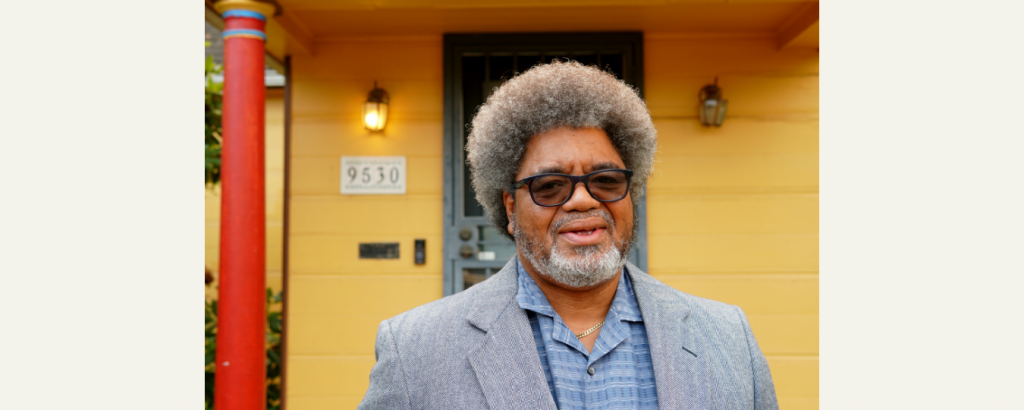
I first met Pastor Robin Wisner at a march in Maywood Park he co-led and enjoyed his quiet humility and eagerness to share wisdom. He’s running for city council of Maywood Park, and I think you’ll enjoy getting to know him! You can follow his campaign at his Facebook page.
By the way – Parkrose Life is now a podcast available on Apple, Spotify, etc. Listen to the first episode!
Here’s my chat with Robin!
What was it like to co-lead a march in Maywood Park on 4th of July?
Amazing! When I think of what was given to me as trust from the young ladies who asked me, the community that came, and Ashley Brassea who [all] listened to what I had to say, I felt that I was at a point of life where I was prepared from all my experiences, all that I’ve done, and where I’ve been. It gives me now the sense to be a beacon or light to share what I can do and start moving in that area.


What questions did those teenage girls from Parkrose High School ask you or appreciate about what you shared with them?
The history and support, those two right there. Bringing Dr. Leroy Haynes out who was a former civil rights leader, someone who had the courage and strength to bring about change. The hope they have with that kind of guidance and wisdom place to speak that language too. Where I was able to be successful and feel good about what they were gleaning from is the appreciation of someone listening to them and helping them to be able to express themselves openly and feel that comfortable because of listening to their stories.
Listening to the one young lady who spoke (Khalia Jabbie)—that was really in my mind a powerful message of how blackness always seemed to be considered bad, but what she embraced her hair, her lips, her walk, her talk, her emotions—captivating that in her speech. Knowing that I actually got the opportunity to hear her express what she was fearful when it came to police, which was different too because the twist is I have relationships with government officials and police officers. Being comfortable with that and understanding the structure of that almost gives a disadvantage of not hearing or not understanding a generation that has expressed a difference in their view. Her view gave me a vision of our granddaughter with her friends at a mall, and then all of a sudden fear comes over them when they look over and see someone who’s an officer. I didn’t want that to ever be a part of what a day would be like for my granddaughter with her friends, and that was Black and White experience, not just Black.
So can you serve as a liaison as someone who knows elected officials, police, and the Black community?
How I capture that is I take from a young age coming into an all White neighborhood and school, being interviewed […] I’ll never forget the question asked of me, “What do you expect since you’re here?” As a young black kid from that point there, you don’t have no expectations when you’re going to a school other than being a person and a friend—this was in the ’70s. My response was, “I hope the girls like me.” Being published like that, I realized that I had to fight my way through school every day because this is the ’70s, and a Black man and a White girl are not supposed to have a relationship. I remember my first girlfriend being white, and how we had to sneak out. I showed you my grandkids who are mixed-race. I had to come to a place where I see now that I was building that gap where it was going to be safe for them [my children] to make a choice of what they choose with whoever they chose it with, that it was acceptable and to be able to understand what I was able to give to them the experience of knowing what to expect with an interracial relationship and give them some depths of connection.
Robin shared that he has been a pastor since 2001 and pastors Under the Blood Ministries in Northeast Portland. He also shared about a group he’s part of, Albina Ministerial Alliance, and his role within it.
Albina Ministerial Alliance is an organization where pastors were going to have ecumenical growth development and relationships, but then they branched out into social justice and dealing with some of the city’s points of being able be the person or group that would be the leaders that spoke to the powers to be whether it was the governor, mayor, or police. My involvement was I came on as a board member during the shooting of Kendra James. I led subcommittees out of that, the investigating committee, which detailed taking the actual scripts from the police bureau of all the shootings. We would break down and actually go through it with a fine comb and make recommendations to the city for changes inside the Portland Police Bureau. The only recommendation from the Albina Ministerial Alliance was to change some of the training and policies inside the bureau. It was adopted.
How have your experiences as a board member of the Albina Ministerial Alliance and as a relational pastor prepared to you be a city council member?
Understanding structures and entities, how they operate. From a city council perspective, recognizing that we’re gonna be meeting with different issues, and every issue is different and [needs] a satellite perspective of how we hear it, what we see, bring resolution to talk it through, and being able to implement it. From the pastoral perspective, it is more of an opportunity to know people and hear people and know exactly what is expected out of our community, what they’re asking from us and being able to represent that for them.
How do you characterize Maywood Park for people who aren’t familiar?
I tell people it’s like Mayberry RFD. I love the community 4th of July and get to know your neighbors with Mayor Hardy, the events on Easter—watching our community come together and seeing how we can help with the children. Everyone coming in decorating on Christmas trees, the events of gathering together and knowing one another. That’s how I saw Maywood Park when I first moved here. It’s a little different now. We don’t gather; we have not gathered, maybe more so because of the pandemic.
What has been your experience as a Black person in Maywood Park?
I see people not sure what to expect. I look at it that way because there’s so many depictions of what a Black person is, and when you don’t know and you see a Black person in Maywood Park walking through and not knowing what to expect, do you embrace what they’re doing and all that? You get that sense sometimes. There are some people I encounter walking through Maywood Park that are embracing. Now with civil unrest taking place, people are wanting to talk more and wanting to get to see different perspectives.
Robin also shared advice that if you see someone in the neighborhood you’d like to know, talk to them and hear their stories and treat them as a neighbor, not foremost as a member of a particular race.
We talked about the Maywood Park police who are under the Multnomah County Sherriff rather than the City of Portland. One problem Robin noted is that if Maywood Park needs backup support or someone to fill in, officers coming from other parts of Multnomah County like Gresham are not used to the diversity Maywood Park has and have been overtly racist in their conduct.
Making changes to police policy with all the bureaucracy is difficult. Do you think Maywood Park is in a unique position to make changes as a smaller entity?
Yes, it is going to be difficult because it’s a total different structure, the county sheriff. […] Working with the upper management team, which is the Sheriff himself, Mike Reese—I remember Mike Reese when he was Officer Reese—so there is a trusted relationship to talk about things if we see things or partner with Maywood Park […] if we’re having problems and we want to know specifically about changes.
So what changes would you advocate for as a city council member?
The first thing I’d like to see is more community policing. Community policing is more of getting out and knowing who your actual neighbor is, police knowing the community, working partnerships side-by-side, working through relationships and information. Dialogue — I would like to see more communication from the Multnomah Sheriff Department to be able to bring policy changes we are not aware of that are actually controlled by this area.
There’s a lot that goes daily in changing and building working relationships whether it’s hearing from the community because I’m sure there’s a lot of bad interactions the community has had that we’re not aware of. There should be some kind of communication to our city council.
What spurred you to want to seek office?
This movement. This takes me to an emotional point. John Lewis. Change. He said, “getting in good trouble.” My mind thinks of a man who actually paved the way. It’s time for me to pay back what he’s done for me. I got the opportunity to thank him personally for what I feel my rights as a Black American are that were achieved through his sacrifice and efforts of office. It is a responsibility to those who have been groomed through the Civil Rights benefits for a generation that is looking for the leadership and guidance, and that drives me to say it’s time not to sit by the wayside especially if your number is being called.
There is a lot of faith-based language in your campaign—it’s part of who you are. What do you see as the role of your faith in how you would work as a city council member?
Truth is always what I underline. My interaction is always going to driven because of what I have as a base of faith. The responsibility of that is my truth, to be able to speak into people where if it’s hidden, it needs to be talked about. It needs to be exposed; it needs to be said. And that’s how I’ve operated for my whole walk even with the City of Portland. It’s making sure people were held accountable, standing in the areas of what it is, and not guiding anyone as far as what they have as faith or hope, but I believe everybody is accountable to tell people who are trusting them, to speak truths to them.
The Portland Tribune wrote a feature story about Robin and his work on the Portland Police Bureau’s Crisis Response Team in 2003 titled “Cool head, quiet words help in violent times.” It’s a great read and speaks to Robin’s unique pastoral care and longstanding service.