


City Council candidates share qualifications, vision
By Rob Cullivan
Contributing Writer
This November, Portland voters will select 12 city council members in the first election held under the new City Charter. Under the new system, voters will select three council members in each of the city’s four districts. Parkrose area voters reside in District 1, which covers several neighborhoods east of Interstate 205 all the way to the Gresham border.


Parkrose Life recently reached out to several declared candidates for District 1, asking them to state their positions and qualifications. We have edited their responses for clarity and length. To learn more about each candidate, read other articles in our series.

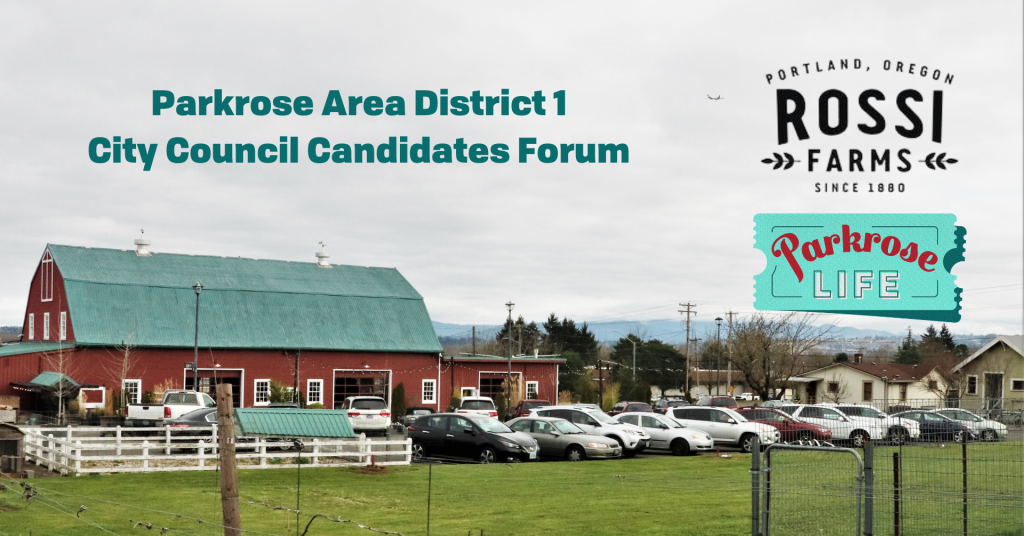
If you want to learn more about these candidates, stay tuned to parkroselife.com and Parkrose Life on Facebook. Hear candidates and meet them in person at the historic Rossi Farms barn on Wednesday, October 16 at 6:00 pm!
This article is the second in a series of articles that will outline how the candidates think on various issues as well as why they believe voters should support candidates.
Question 1: We live in a divided time when people have increasingly become uncivil over political and social issues. How would you work with both constituents and fellow city councilors who either disagree with you on issues or prioritize issues differently than you? How would you set a tone that unites, rather than divides, people of different political persuasions?
Candace Avalos
Avalos notes she has served as a nonprofit executive and educator, experiences that mean “I have worked with colleagues and students I didn’t always agree with.
“As a member of the council, I would prioritize building strong relationships with council colleagues to build camaraderie, ensuring when tough decisions need to be made, we’re making them for the best of Portland.”
Cayle Tern
“As a Reynolds School Board Director, my experience has always been about transparency,” Tern says. “It is no secret that we will have differences of opinions. We will not see eye to eye about solutions. What’s important is that everyone understands the decision that is made.”
Tern notes that the Portland City Council is nonpartisan.
“I see everyone in my neighborhood and everyone should have a say in what we want in our neighborhoods,” he says. “I will do what I believe is best for our communities and look for things that we can unite on.”
He adds that District 1 will be competing with other parts of Portland and needs to stay united.
“East Portland has been overlooked for a longtime, so we need to all work together.”
David Linn
A community organizer for more than two decades, Linn says he’s used to people not always agreeing with him.
“I was always able to make connections with people over our shared values and our common desire to see our families and neighborhoods thrive,” he says. “I have always looked at volunteer positions as service to the public and not service to myself. I am someone who shows up ready to do the work and not just the talking. When you are focused on the work, the politics don’t matter.”
Jamie Dunphy
Dunphy says Portlanders have more in common than not.
“Everyone wants clean streets, well maintained and safe parks, and jobs that pay enough to prevent poverty and give a path toward economic success,” he says. “We want robust small businesses and culture and music and art. We want potholes filled and new sidewalks and working streetlights. We want to feel welcome and safe in our community.
“We need to return to the basics of how government can make your life just a little bit better and can encourage the types of outcomes that lead to the thriving community we all deserve,” Dunphy says.
Dunphy adds that East Portland is not as easily pigeonholed politically as the rest of Portland – a quarter of district voters are Democrats, another quarter Republican, and the rest are not affiliated with either major party.
“Portland City Council is a nonpartisan role, and I will approach this office that way, prioritizing constituent services, and getting real results that meaningfully improve lives.”
Noah Ernst
“I work to build from commonalities, rather than focusing on differences,” Ernst says. “What things do we all agree on and therefore can accomplish?
“I don’t know everything about every topic. No one does,” he adds. “I will listen to people who disagree with me to find out if they know something that I don’t.
He added that it’s important not to descend into character attacks when disagreeing with someone.
“Most people are good people who want to make things better,” he says. “We disagree on methods, not goals. In the end there is no justification for being uncivil, regardless of how the other person behaves.”
Sonja McKenzie
“I will bring to the City Council seven years’ experience discussing, deliberating and sharing ideas with fellow members of an elected body, community members and stakeholders,” McKenzie says. “As a city councilor I will be open to new ideas, other points of view and I will listen to understand always, keeping our goal in mind as we reach a decision collectively as a City Council.”
Steph Routh
“We are faced with steep challenges,” Routh says, “a climate crisis, a housing emergency, an expanding wealth gap, a pandemic; and meeting those challenges is going to take all of us.”
Routh notes she’s used to creating coalitions.
“As former executive director of Oregon Walks, I developed and supported a number of coalitions,” she says. “One of Oregon Walks’s values during my time there was that we never walk alone to pursue worthy goals. We didn’t then, and I’m so proud to see the organization continuing that tradition with their current work.
“I am constantly in search of, as one of my favorite legislators used to call it, ‘the honorable opposition,’” she adds. “We will not always agree, but it is my consistent goal to not surprise my friends and to find collaboration across differences.”
Terrence Hayes
“I will continue to listen and build relationships like I already do now with people who disagree with me,” Hayes says. “I know I am not going to agree with everyone on everything but I know we can find a reasonable middle ground.”
Timur Ender
“I would start with where there is agreement: we all want to live in healthy neighborhoods with access to school, food, and community resources; we want to feel safe and be secure where we live,” Ender says. “I’m committed to listening and meeting people where they are.
“As someone who has worked in city government, I also know that resources, time, and staff are finite; this means we have to be strategic,” he adds. “Every council member has an agenda they are working toward. There are often areas of overlap where we can agree on common goals, shared priorities, and desired outcomes. While the other councilors and I may not align on everything, I will leverage and champion the things we do agree on to pass policies and budgets that will support the needs of East Portland.”
Question 2: What problems do you feel you are best equipped to address as a councilor?
Candace Avalos
Avalos says she’s best equipped to tackle the issues of community safety, housing & homelessness, and environmental justice. She then outlined how she would do so.
Community Safety: “East Portland deserves a responsive and accountable public safety system tailored to our specific needs,” she says, noting the increase in “break-ins and gun violence exacerbated by the pandemic.”
Avalos says she will prioritize expanding Portland Street Response, which provides crisis intervention without armed police officers.
“Modernizing our public safety system to deploy the right responders for the right calls will help create a safer Portland for everyone.”
Housing & Homelessness: “Our area often becomes the refuge for those priced out or displaced from other parts of the city,” she says. “Instead of empty promises, we need immediate, effective action. Solutions include keeping people in their homes, offering diverse shelter options, and quickly providing housing with supportive services.”
Environmental Justice: “Environmental injustices have long plagued East Portland, resulting in urban heat islands, poor air quality, limited green spaces, and inadequate infrastructure to combat greenhouse gas emissions,” she says. “The threat of heat waves and wildfires intensifies each year, necessitating urgent solutions to strengthen community resilience.”
The executive director of Verde, a nonprofit that brings environmental investments to Portland’s neighborhoods, Avalo notes she has led efforts to install cooling devices for seniors and vulnerable households in economically neglected areas similar to much of East Portland.
“The Portland Clean Energy Fund, approved by voters in 2018, offers a historic opportunity to address these injustices,” she says. “As a vocal environmental justice leader, I have directed critical funds into our communities and will bring that advocacy to City Hall.”
Cayle Tern
Tern listed homelessness and poverty as issues he’s qualified to tackle, pointing out he holds a master’s degree in social work and has more than 15 years of experience with the state’s Department of Human Services. He also worked as a housing advocate in Vancouver and worked an internship in mental health.
“I understand the challenges that marginalized communities experience,” he says. “As a refugee from the Lao Civil War, I also know what it feels like to be poor with parents who couldn’t read or write in English … My unique set of experiences will help me guide the work I am prepared to do.”
David Linn
“As someone who has worked in government for 15 years and the only candidate with a master’s degree in city government, I bring that scrutiny and expertise in pushing government to better serve the people,” Linn says. “Whether it’s public contracting or intergovernmental agreements, I have the experience to look at the details, ask the right questions, and fight to ensure that the public is getting the best deal for their money.
“We need to reinvigorate a system of neighborhood involvement that brings people together, informs them about their local government, and empowers them to make real changes in the plans that affect them and their families,” Linn adds.
Citing his decades of community involvement, he says, “I can show people what is working and what is not. It is not just about giving people a say in their local government, it is about bringing citizens together to learn about each other and grow together.”
Jamie Dunphy
“I know how to work within these complicated systems and across different governments, how to build meaningful and lasting coalitions toward common goals, and to deliver results,” Dunphy says. “I have worked for two of Portland’s best public servants, U.S. Senator Jeff Merkley and Portland City Commissioner Nick Fish. I learned what leadership looks like, and how to represent the communities that elected you, and how to act with urgency toward real results, not performative politics that have no real outcomes in the lives of everyday people.”
Noah Ernst
“I believe that my biggest strength as a city councilor will be my focus on outcomes over policies,” Ernst says. “The biggest frustration I hear from constituents is that Portland spends huge amounts of money on programs that aren’t delivering results.”
Ernst also addressed the perception East Portland gets overlooked by city leaders.
“I am committed to listening to what the communities of District 1 want and need from the city and advocating for them,” he says. “I want to meet people where they are and work to make their lives better.“
Sonja McKenzie
“My strengths and experiences are in the areas of negotiations with labor unions during bargaining, budget review, evaluation and negotiations, collecting, listening and evaluating community feedback and board deliberations, discussion and reaching a consensus with an elected body.”
Steph Routh
Routh said she is best equipped to address climate change, housing, transportation, and government accountability.
“We can address our housing crisis and our climate crisis together,” Routh says, noting her Lents neighborhood suffered greatly during the June 2021 “heat dome” event which killed more than 200 people in Oregon and Washington.
“Local threats include extreme heat events, such as the heat dome event mentioned above, and extreme cold events, such as our recent weeklong ice storm,” she says. “Either one would impact our community’s already precarious urban tree canopy, but both create the conditions for tree canopy loss at a level our neighborhoods simply cannot tolerate. We need a serious focus on housing affordability as well as shade equity citywide and a coordinated effort to protect our most vulnerable neighbors during extreme climate events.”
Routh also notes her belief that climate change is related to transportation safety.
“Most investments in East Portland have been to make it a convenient place to drive through, not a nourishing place to live in,” she says. “Our transportation sector is the source of over 40% of our greenhouse gas emissions, and we are witnessing in real time—through extreme heat events and wildfires—the impacts of climate change on our neighborhoods. The future of our transportation system has to center walking, cycling, and public transportation …”
Routh also noted the new city government system must be more accountable than it is currently to the public.
“A century of our current commission form of government has resulted in bureaus operating as silos,” she says. “We need to create new pathways between bureaus to advance a culture of collaboration and achieve the cost savings we desperately need in order to deliver basic services—from pothole repair to welcoming parks—that Portlanders should expect from their local government. We also need to knit East Portland into the fabric of citywide decision-making. East Portland has long been left behind in terms of investment and involvement.”
Terrence Hayes
Hayes listed “public safety, livability and small business development” as the issues he’s prepared to tackle.
“I mentor incarcerated Black men and encourage them to learn a trade and become their own boss to make a living wage so they do not return to a life of crime,” he says. “I understand the intricacies of government contract billing issues that keep minority-owned businesses from being paid in a timely manner, threatening their livelihoods. And I work with the community and law enforcement by encouraging conversations and data-driven approaches to solutions.”
Timur Ender
“I feel most equipped to address gun violence, transportation, and community development,” Ender says, noting he majored in criminology and has served on the Multnomah County Public Health Advisory Board “where I gained a greater appreciation for equitable health outcomes.”
“East Portlanders have a 10-year lower life expectancy than those living west of 82nd Avenue,” he says, “This is due to historic underinvestment, traffic crashes, and gun violence, among other things.
“I am a strong believer in place-based interventions to gun violence,” Ender says. “This includes street lighting, access to green spaces, and tree canopy. Additionally, I am a strong proponent of the ceasefire program which provides intense wraparound case management to those most at risk of committing gun violence. I will also support gun violence prevention grants to organizations doing street level outreach to connect with people most at risk. While the city government doesn’t control gun laws, I am excited to champion evidence-based policies that have been shown to reduce gun violence at the local level.
“Additionally, as someone who has managed millions of dollars of voter-approved infrastructure projects as part of the Fixing Our Streets program … I have experience with public administration and project management and (will) work to ensure that scope, schedule, budget, and risk are appropriately managed, particularly for large capital projects.”
He also noted he had been involved in a number of community development initiatives such as increasing bike ridership in the Gateway district and supporting walkability in the Rosewood area.
“Unlike other parts of the city which are mostly developed, East Portland has some major development opportunities in the coming decade,” he says “I’m excited to dig into land use and zoning so that the future development of East Portland is in line with our values as a community.”
Question 3: Can you share a time you promoted an idea or policy that others didn’t value? How do you convince people that an idea or policy you’re championing is worth pursuing?
Candace Avalos
“Serving on the city’s charter commission I learned deep lessons about collaborating across differences,” she says. “A unique group of 20 Portlanders came together to re envision the city we deserve, and these ideas were challenged heavily – particularly (by) people who stood the most to lose from their current grasp of leverage and power in our city.
“Despite these ideological differences on the commission and in the community, we built something better for our city, alongside our city, and we won the support of Portland voters as the naysayers continued to stack up,” she adds.
Avalos says the commission is confident the new charter increases representation and “reflected the true wishes of constituents, particularly those of us living in East Portland,” and would “upgrade a government infrastructure desperately in need of 21st century governance best practices.
“Working collaboratively with thousands of Portlanders meant everyone believed in this vision and are committed to seeing it through,” she says. “That is one of the biggest reasons I’m running for city council, and I will bring more of this collaborative spirit in my representation of East Portland in City Hall.”
Cayle Tern
“As the Civic Engagement Manager with the Asian Pacific American Network of Oregon (APANO), I have succeeded in advocating for several bills in the State House,” Tern says.
Tern noted he has worked for three years with Food for All Oregonians, a coalition of various groups working at the legislative level to create a “hunger-free Oregon.”
“When it comes to advocating for policy that people are not interested in, it is a slow process,” he says. “We want to make sure that we provide education and transparency to all stakeholders. We need to listen to people and address people’s concerns about the policy; making amendments where you can. We need to find our allies to build coalitions and networks of support. Most importantly, we need to build and maintain trust and relationships among stakeholders.”
David Linn
“I once organized a ‘legislative liaison’ committee at the neighborhood association to serve as a channel of communication between the community and our elected representatives,” Linn says. “Each person would be assigned to a different representative and communicate back to the group various updates.
“It was difficult to show people the value until we began receiving more responsive interactions with our state representatives,” he says. “We helped push … the conversion of 82nd Avenue from a state highway to a city street, along with the funds to upgrade the quality of the road. Once people started to see results it was far easier to get them to spare their time and energy.”
Jamie Dunphy
“Sometimes you can have near unanimous support for an issue, and it can still take years to accomplish an outcome,” Dunphy says.
He notes that as part of his work with the American Cancer Society Cancer Action Network, he’s spent three years on a campaign to end the sale of all flavored tobacco products in Oregon.
“Despite broad bipartisan co-sponsorship in both chambers of the Legislature and nearly 70% public polling support, as well as successfully passing policies in Multnomah and Washington Counties, the State Legislature has yet to take action,” he adds.
“Countless lawmakers have told me that they support this effort, but don’t have the capacity to lead on it or make it a priority,” he says. “I have spent the last year working on the local level across the entire state to demonstrate community support for these policies, including getting city councils in conservative and more rural areas to pass resolutions in support of this policy, getting compelling op-eds published in newspapers across the state, and finding ways to convince individual lawmakers to prioritize this.
“If I’m … elected to City Council, I will take the skills and resourcefulness that I’ve honed through this multi-year campaign and empower community voices, individual stories, and urgent action on the biggest issues our community is facing.”
Noah Ernst
“I was the spokesman for a taxi industry coalition that formed to fight for fair and safe private for-hire regulations when Uber and Lyft were being let into Portland,” Ernst says. “It became clear very quickly that no one involved in the process of creating the new code valued our input or ideas. I have been fighting for fair and safe private for-hire regulation ever since.
“Convincing people that an idea or policy you’re championing is worth pursuing is frequently about showing how the other person benefits from your idea,” he says. “Show them how it meets a goal they are interested in achieving.
“When people don’t have your specific knowledge or expertise, it can be hard for them to see your point of view, but as they learn about the issue over time, they may come to see it your way.
Sonja McKenzie
“As a founding member of the Oregon School Board members of Color Caucus, (OSBMCC) we were tasked with sharing (a) proposal/resolution sent to all 197-member school districts for a vote in 2019,” McKenzie says. “As a regional representative, I (talked) to individual members from my region about the goals of the caucus and answered any clarifying questions.”
She listed the goals as follows:
- Building positive and effective coalition among school board members of color, their communities, political leaders, in Oregon.
- Develop, promote, and advocate for legislation to support and improve educational opportunities and outcomes for students of color.
- Build capacity of the general board membership statewide in understanding the issues of people of color.
“My colleagues in my region voted ‘yes’ unanimously!” she says. “The advocacy of all of the inaugural members statewide resulted in a ‘yes’ vote to the resolution.”
McKenzie was a leader on the regional leadership team and a secretary/treasurer for three years, and noted, “Today, the OSBMCC is the largest caucus of Black, Indigenous, and elected officials of color in Oregon moving forward with a growing membership and focus on their mission.”
Steph Routh
Routh noted her work as a sophomore in high school against the 1992 Oregon Ballot Measure 9, “one of the harshest anti-gay measures presented to voters in American history.
“I knew that if that bill passed, I could work as hard as anyone and still be fired simply for being who I was,” Routh says. “And so, on the weekends, I canvassed for a state representative who was against the ballot measure, coming out to strangers on their porches in the process. It was terrifying. The ballot measure’s defeat marked a turning point, for this state and for my life.”
The defeat inspired her, she says, as well as influenced her future.
“I was proud of my neighbors for choosing to reject hate, and I realized the importance of literally walking my talk, of meeting people where they are, and organizing in common cause.”
Terrence Hayes
Hayes says he works with both community-based organizations doing community violence prevention work and the police and says, “those ideas are not contrary to each other.
“I am working with both entities to build safer community environments,” he says. “Talking to the community and say I know you are hurting but please give (the police) time to staff up and recover. Talk to officers – they are hurting, too, from (the) 2020 protests.”
Hayes notes he has chaired the Focused Intervention Team Community Oversight Group.
“Police stops data report shows officers were disproportionately stopping black people,” he says. “Instead of using that as a way to attack officers, as chair I sat down with officers to talk and understand why. In trying to reduce gun violence, a higher number of stops occurred in those communities.
“The interfaith community had concerns of over policing and we helped them understand this was the task we gave the Gun Violence Reduction Team and if they didn’t, we would’ve not impacted the gun violence in those communities,” he says. “Two entities looking through a different lens; (we) brought them to the table and helped police to understand this is still a concern in Black community and (that they) need to be even more data driven than this to get these stop numbers down despite the task at hand.”
Timur Ender
“In 2015, I was part of a group of people working to stand up the Fixing Our Streets program, (funded) by the city’s 10 cent gas tax,” Ender says. “We worked with transportation safety advocates, the Chamber of Commerce, labor unions and others to develop a program that met the needs of various perspectives.
“The proposal (included) a 4-year sunset unless renewed by voters, a community oversight group, and a project list so that residents knew exactly what the funding would be used for,” he says. “It was an example of working together to craft policy that would make a tangible difference in the lives of Portland residents.
“Despite the intention to listen to all perspectives and develop a thoughtful proposal, not everyone was a fan and some groups spent millions of dollars trying to kill the proposal,” Ender adds. “In 2016, 52% of Portland voters supported the Fixing Our Streets program which has yielded millions of dollars of investment in safe routes to school, paving, curb ramps, and street trees. A notable portion of these projects have been in East Portland neighborhoods. In 2020, 77% of Portland voters elected to renew the program.”
If you want to learn more about these candidates, stay tuned to parkroselife.com and Parkrose Life on Facebook. Hear candidates and meet them in person at the historic Rossi Farms barn on Wednesday, October 16 at 6:00 pm!